Talentrah
Expanding an AI-powered job platform into a dual-role hiring marketplace.
Role
Product Designer
Industry
Recruitment
Duration
3 months
OVERVIEW
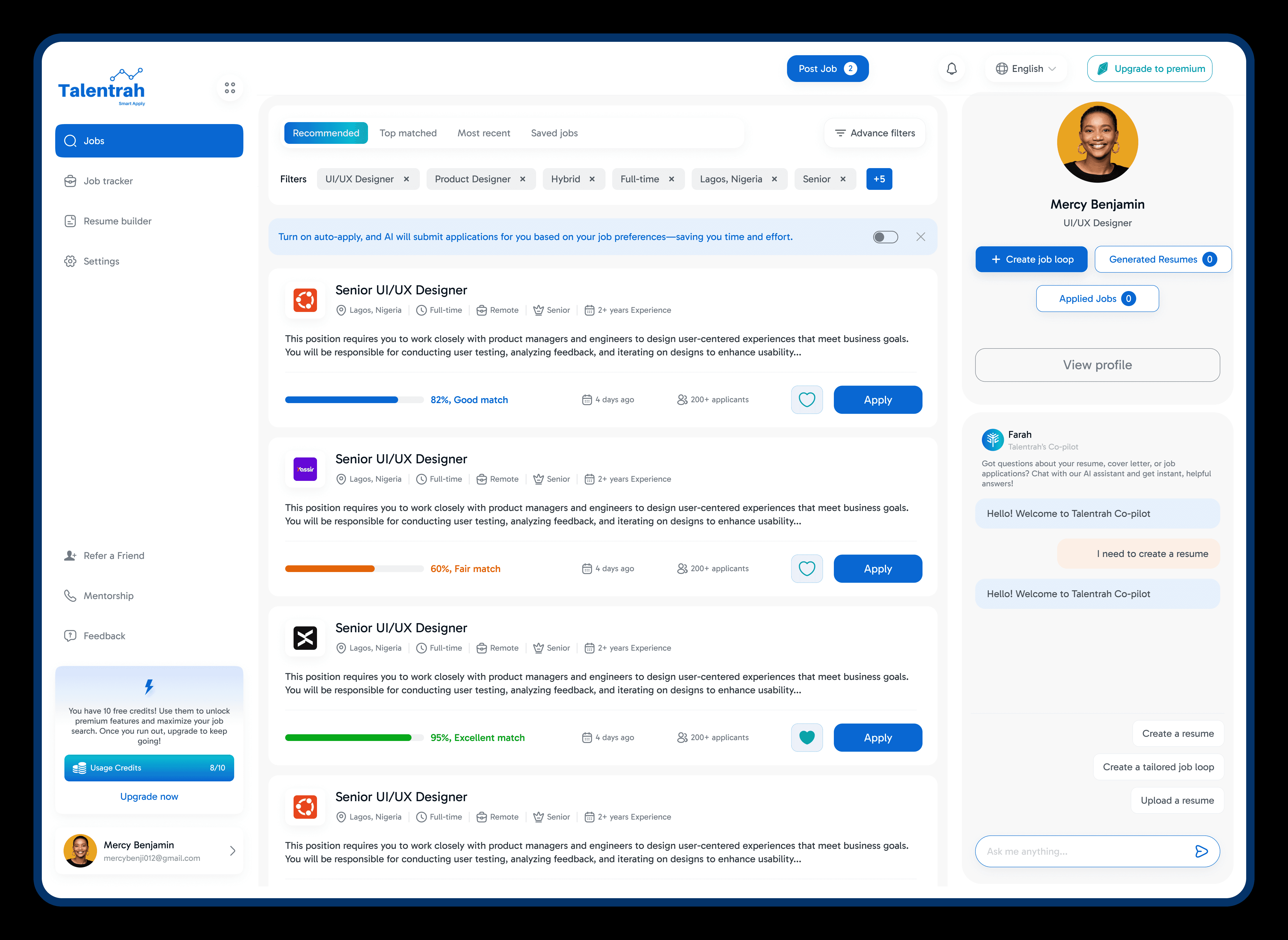
Talentrah is an AI-assisted job platform. On the job-seeker side, AI helps users apply and track applications. But the employer side didn't exist, there was no native way to post jobs, manage listings, or interact with candidates inside the product.
The goal wasn't just to add employer functionality. It was to extend the platform's existing AI identity to the other side of the marketplace, and to connect Talentrah to the company's separate HR platform without forcing users into the wrong tool.
The same user who applies for jobs can post them. No role switching. No separate account. Intent determines context.
PROBLEM
The platform had one structural gap: it only served one side of the marketplace.
For users who wanted to hire:
No native way to post or manage job listings
No visibility into applicants or listing status
All coordination happened outside the product
For the platform:
AI existed only on the job-seeker side, the employer experience had no equivalent
No monetization structure for employers
Architecture assumed a single user type
Navigation and IA were built entirely around job discovery, not job creation
Two additional constraints made this harder than a standard employer flow:
The platform's AI had to be extended to job posting, not as a novelty, but as a functional tool that matches what employers already do manually.
And the company had a separate HR platform handling advanced hiring operations. Talentrah needed to connect to it without confusing users about which tool to use and when.
SOLUTION
I expanded Talentrah into a dual-role platform by carefully extending the current product architecture instead of replacing it.
1. Dual-role model without role switching
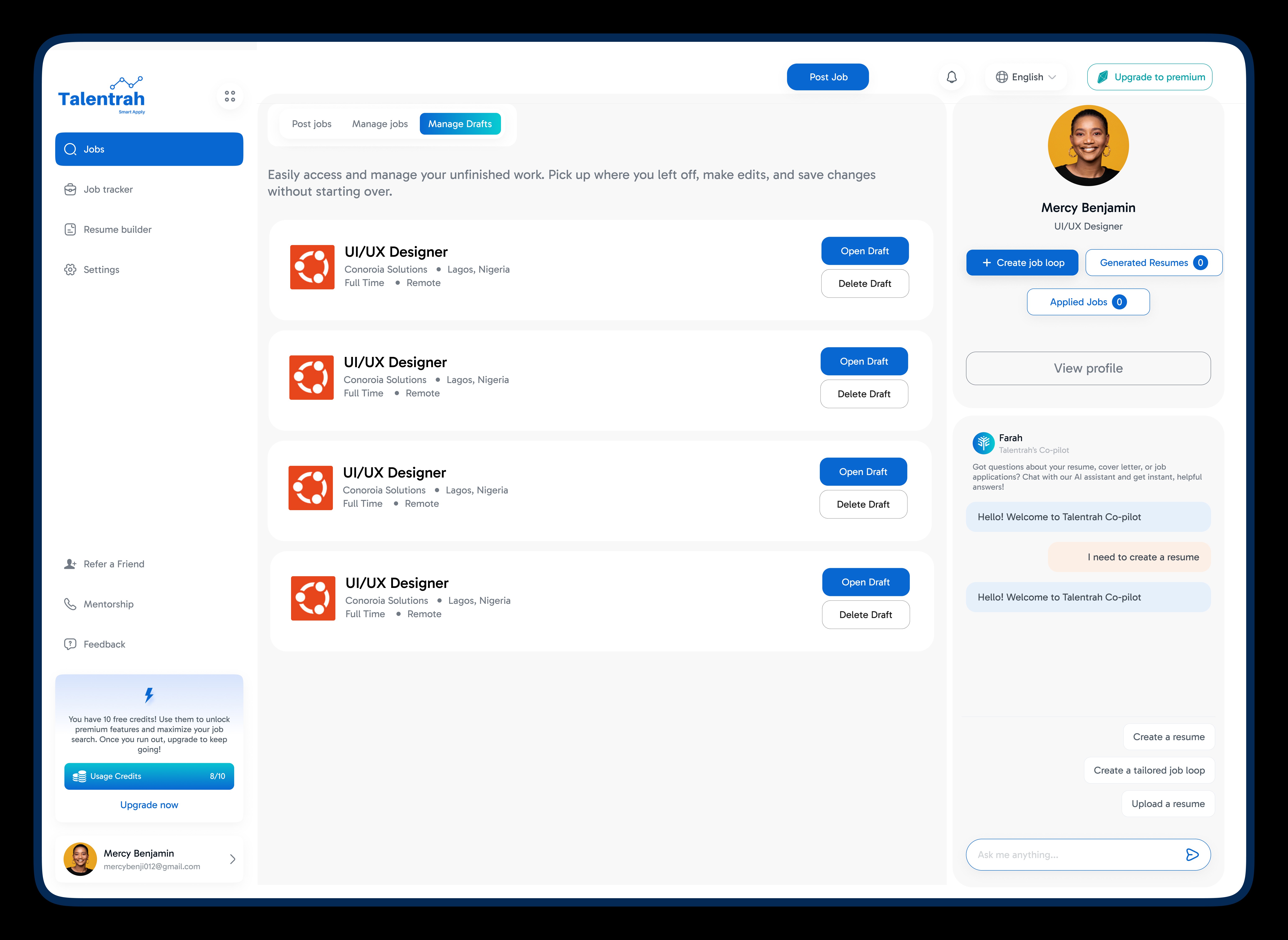
A user is a job seeker when browsing. They become a poster when they click "Post Job." That action opens a separate employer dashboard, built around job creation and management, while the main navigation stays unchanged.
2. AI-assisted job posting
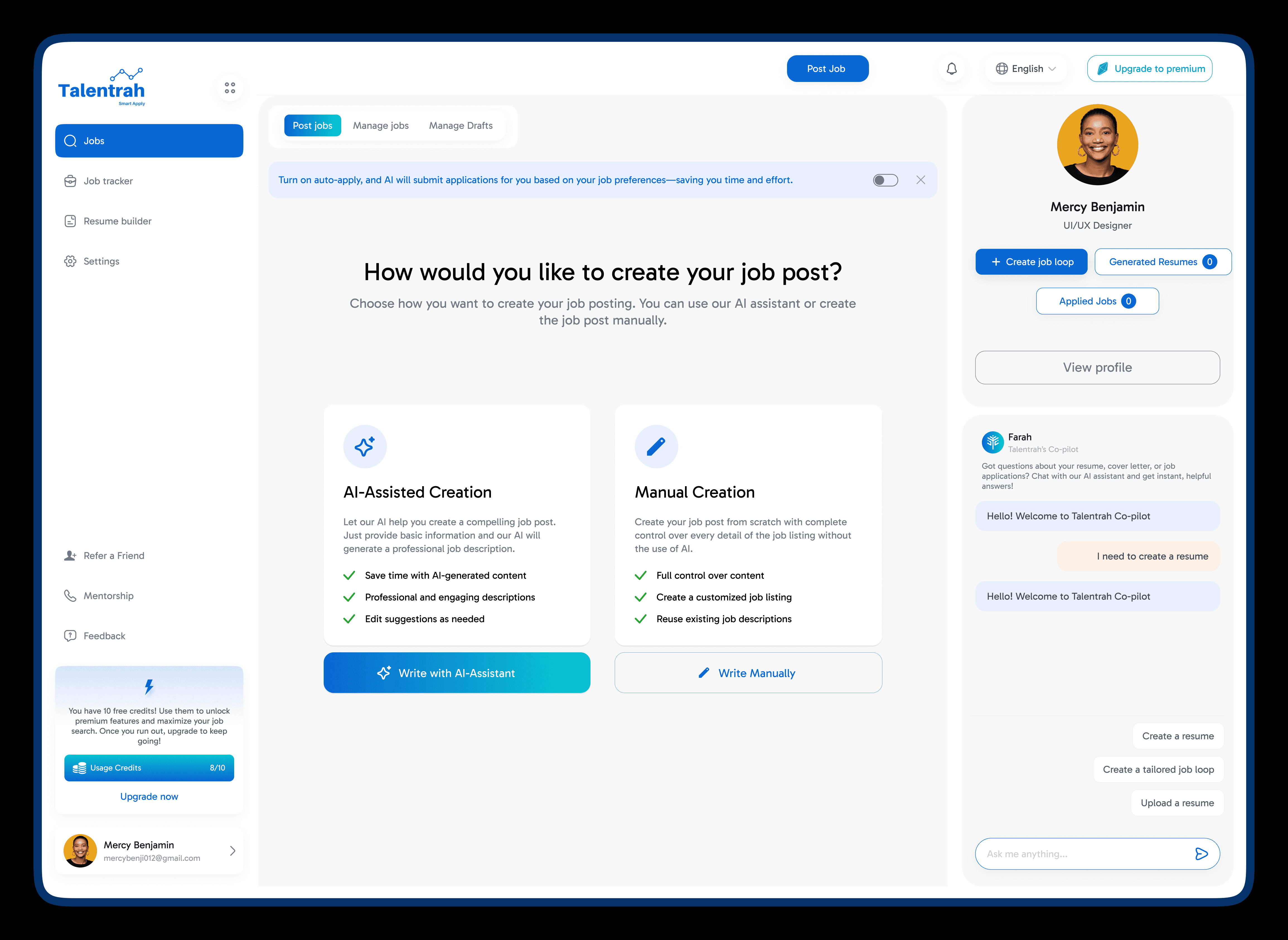
The core of the employer experience is a two-path posting flow:
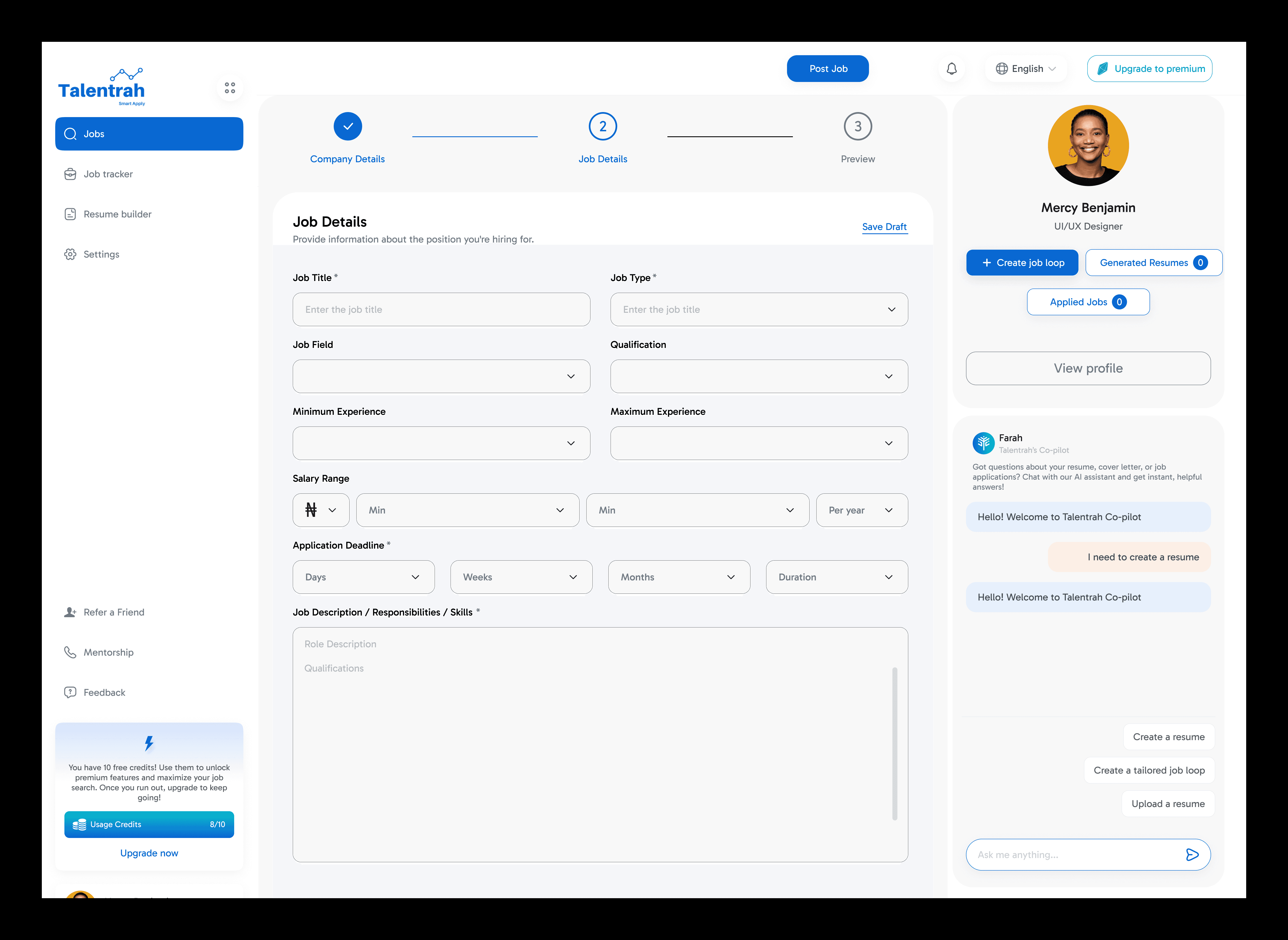
Post with AI : The employer provides structured inputs, company details, job title, type, salary range, and experience level. The AI generates the full job description: responsibilities, qualifications, and required skills. The employer reviews, edits and rates the AI's output.
Post manually: For employers who prefer full control from the start, a manual path is available. Same structure, no AI generation.
3. Cross-platform handoff to the HR platform
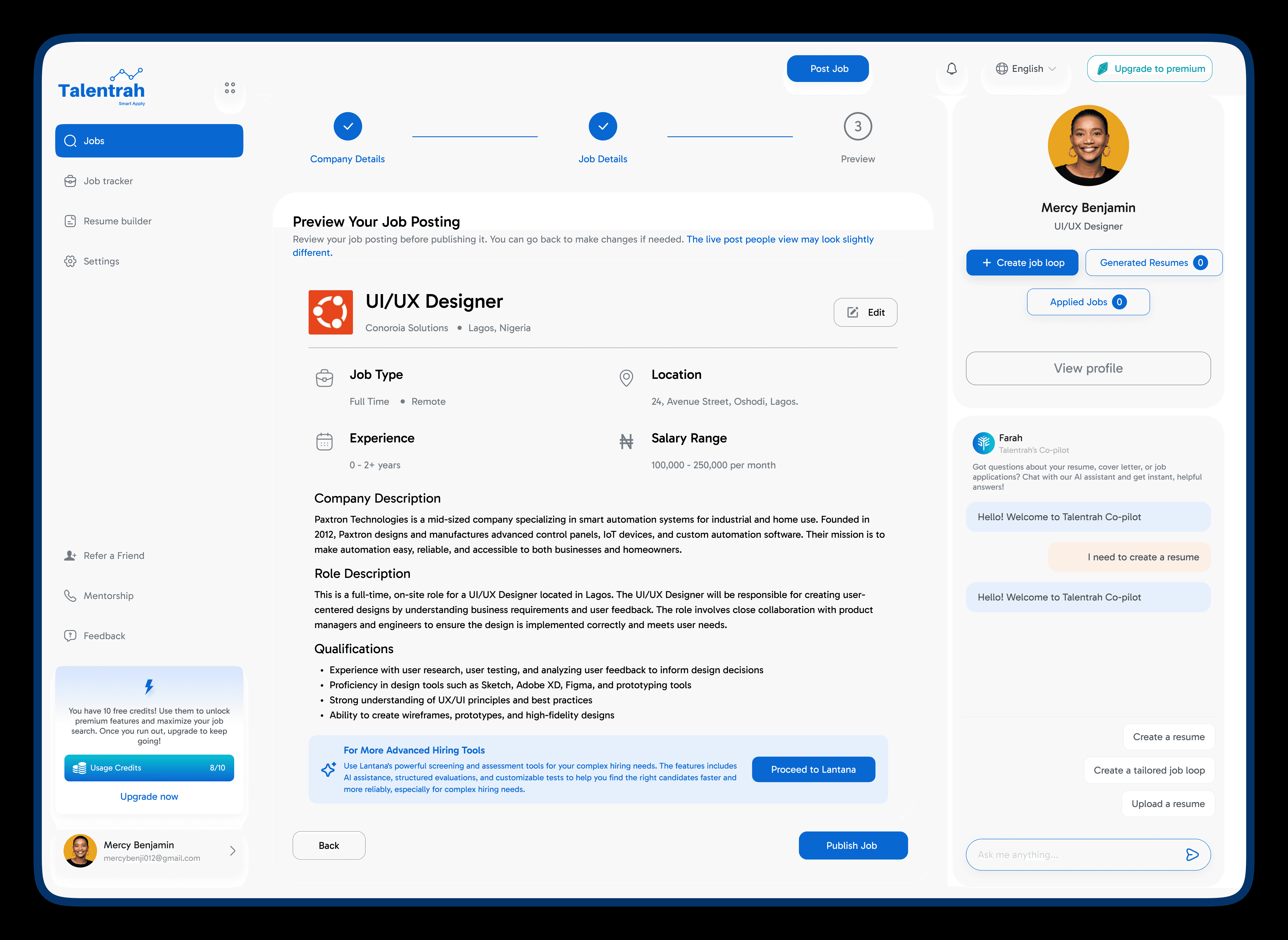
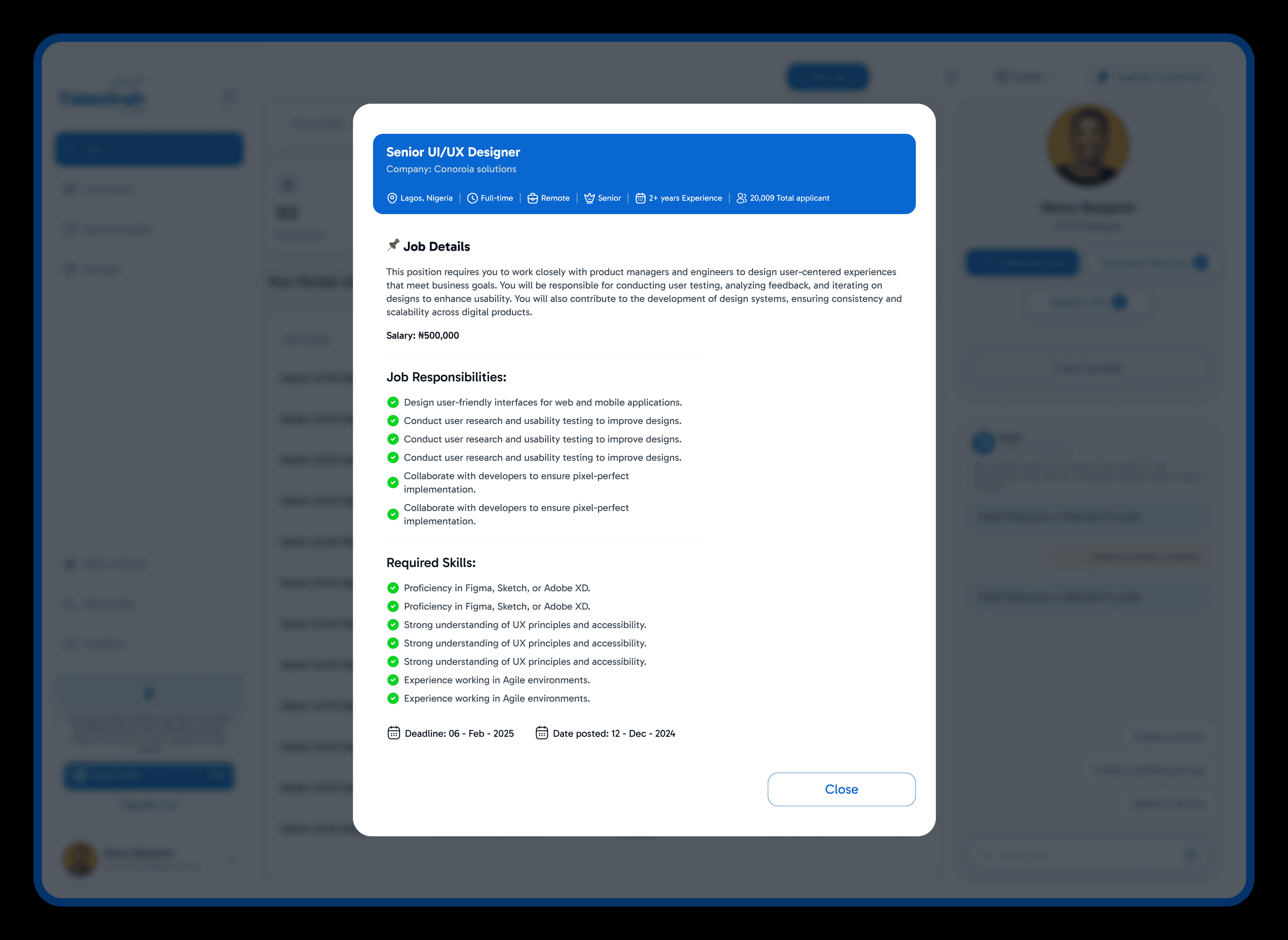
Talentrah handles job posting and basic applicant visibility. The company's separate HR platform handles advanced hiring operations, AI interviews, candidate assessments, structured evaluation, and pipeline management.
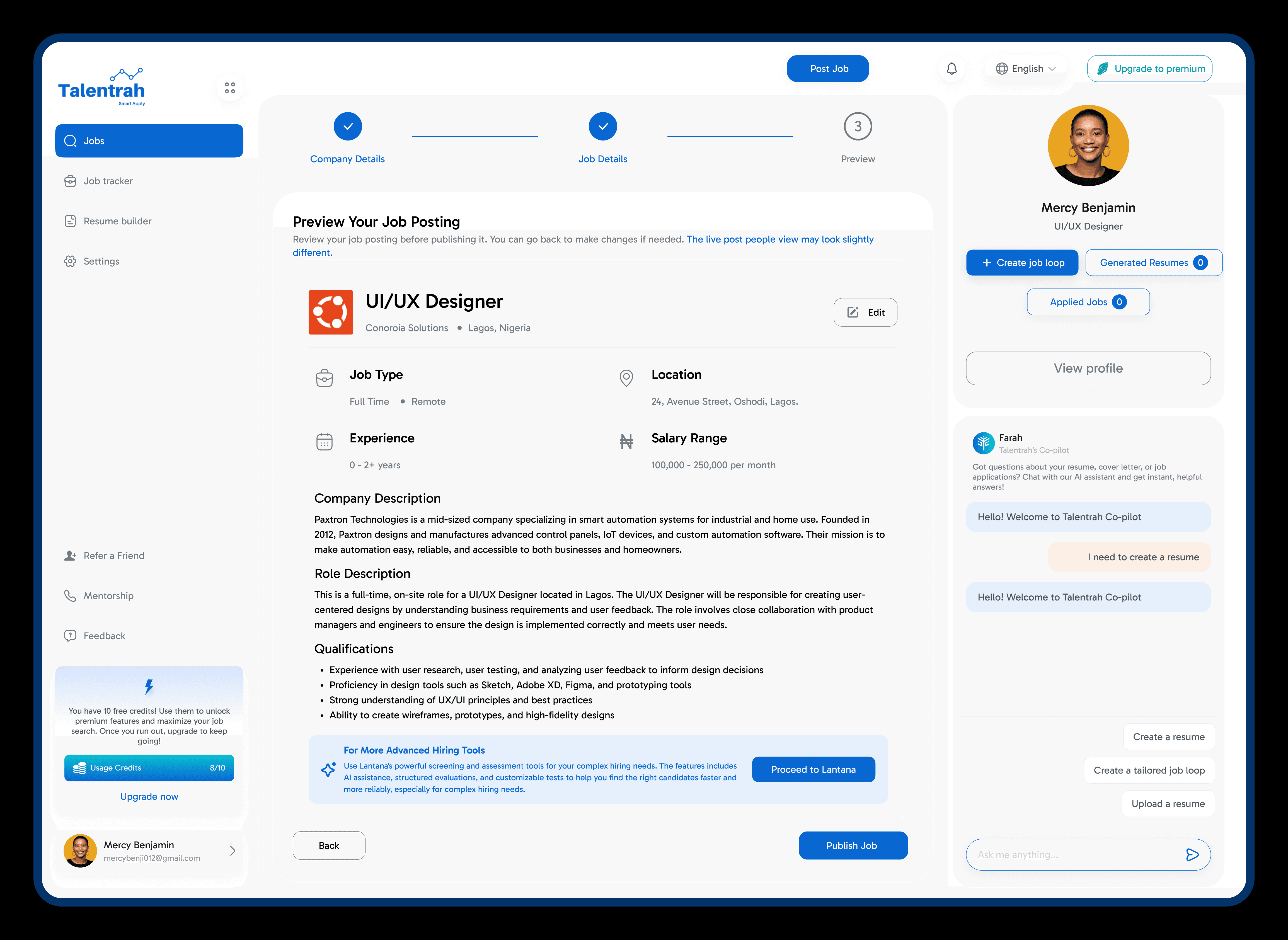
I introduced a handoff point at the job post preview screen — the moment before a listing goes live. At that point, employers are given a clear choice: publish on Talentrah, or continue to the HR platform for deeper hiring control.
4. Job management dashboard
The employer dashboard covers:
Job creation (AI-assisted or manual)
Editing and updating listings
Tracking listing status (active, draft, closed)
Viewing applicants per listing
Scoped deliberately to match the platform's current stage. The HR platform handles everything beyond this.


HOW I APPROACHED THE PROBLEM
The first problem was intent mismatch. Job seekers and employers use the same product for opposite reasons:
Job seekers → discovery, passive browsing, linear application flow
Employers → creation, active management, non-linear workflow
The second problem was AI continuity. The platform's value proposition on the job-seeker side is AI assistance. Introducing a manual-only employer flow would have created a split identity. Extending AI to job postings was a product consistency decision, not just a feature decision.
The third problem was product boundaries. The HR platform already existed and handled advanced hiring. The risk was either duplicating features Talentrah shouldn't own. The preview-screen handoff resolved this; it's the last moment before a job goes live, which is the natural point where an employer decides how seriously they want to manage the hiring process.
Key friction points resolved:
No entry point for job creation → persistent "Post Job" action
AI existed only for job seekers → extended to job posting with structured input and editable output
No connection between Talentrah and HR platform → handoff introduced at preview, with clear framing around what each product handles
Conflicting navigation priorities → separate space, unchanged global nav

OUTCOME
Talentrah expanded from a single-sided job board to a two-sided AI-powered marketplace.
What changed:
Users can post jobs from the same account they job-seek with, no role switching
AI-assisted posting extends the platform's existing identity to the employer side
Employers have a clear path to the HR platform when they need deeper hiring control
Job seeker experience was fully preserved
The platform now supports monetization through job postings
Employer dashboard establishes the foundation for recruiter-facing features at scale
The product is currently in pre-launch, building a waitlist, and in active investor conversations.
KEY TAKEAWAY
Three decisions defined this project:
Don't create roles where intent is enough. The same account serves both use cases. Context shifts based on what the user is trying to do, not who they're designated as.
AI consistency matters more than AI novelty. Extending AI to job posting wasn't about adding a feature. It was about making the employer experience match the platform's identity instead of contradicting it.
Know what your product shouldn't own. Designing the handoff to the HR platform was as important as designing the posting flow itself. A clear boundary between two products is a design decision, not a gap.
Other projects

Cleaques Bookings
A marketplace for trip planning and instant service booking across verified vendors, supported by a structured admin system.

Cleaques Sports
A digital platform connecting street football players, clubs, scouts, and fans through competitions, player discovery, live streaming, and creator monetization.

Study Befikar
Redesigning a study abroad consultation platform for clarity, hierarchy, and usability